

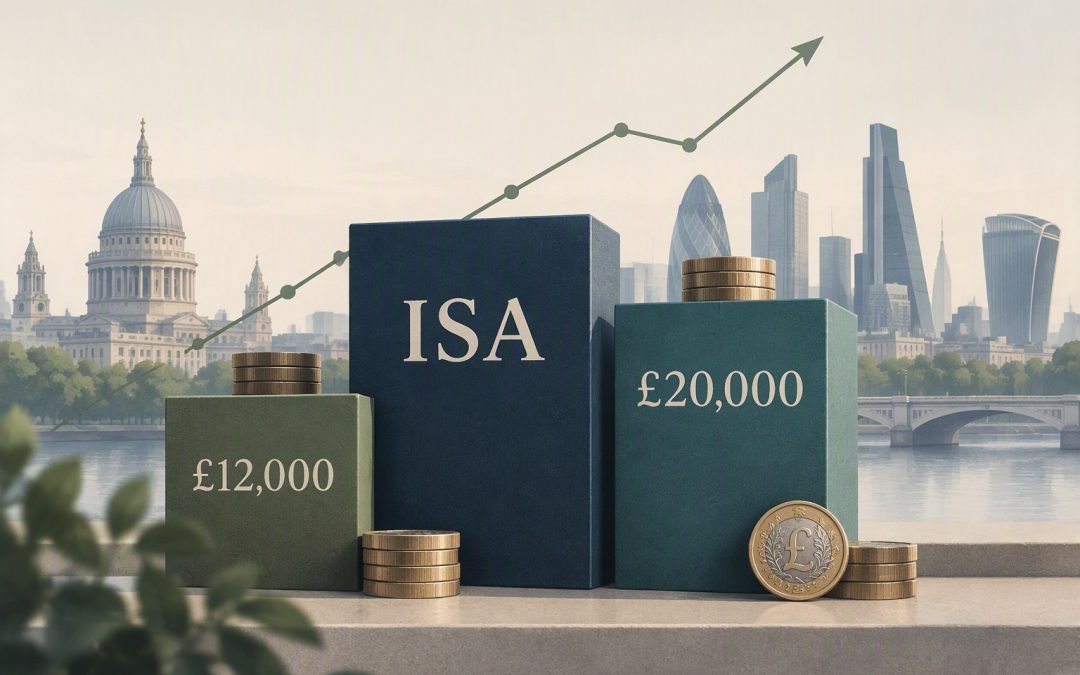
For many years, the ISA rules have been relatively easy to understand. You can save or invest up to £20,000 each tax year, with any interest, income or investment growth sheltered from tax. You can choose to hold the full amount in cash, invest it, or use a mixture of the two.
From 6 April 2027, that broad principle will remain, but the way some people can use their allowance will change. The Government wants to encourage more long-term investment rather than seeing large amounts remain in cash. The result is a new limit for Cash ISAs, restrictions on certain transfers and new rules for cash-like holdings inside investment ISAs.
The important point is that the overall ISA allowance is not being reduced. ISAs will still be valuable and tax efficient. However, the right way to use the allowance may require a little more thought.
The Headline Change: A New Cash ISA Limit
From 6 April 2027, anyone aged under 65 will generally be limited to paying £12,000 a year into a Cash ISA. At the moment, the full £20,000 annual allowance can be placed into cash.
The overall £20,000 ISA allowance will remain.
This means someone under 65 could still pay £12,000 into a Cash ISA and use the remaining £8,000 in another type of ISA, such as a Stocks and Shares ISA. They could also choose a different split, provided no more than £12,000 goes into cash.
People aged 65 or over will not be caught by the new £12,000 Cash ISA limit. They will still be able to place up to the full £20,000 allowance into a Cash ISA. If you turn 65 at any point during a tax year, the relaxation applies from the beginning of that tax year.
What Happens to ISAs You Already Hold?
The new limit applies to money paid into a Cash ISA from April 2027. It does not mean you must withdraw money already held in an ISA, and it does not remove the tax benefits from existing ISA savings.
For clients invested in the Howard Wright investment funds, these changes do not affect the funds themselves. They are held within a Stocks and Shares ISA rather than a Cash ISA, so they are not affected by the new £12,000 Cash ISA limit. The investment funds can continue to be held and used in the same way as they are now.
There will, however, be a change to transfers. People under 65 will no longer be able to move money from a Stocks and Shares ISA into a Cash ISA. Transfers in the other direction, from a Cash ISA into a Stocks and Shares ISA, will still be allowed.
This is intended to prevent people placing the full £20,000 into an investment ISA and then moving it straight into cash to get around the new limit. For clients approaching 65, the timing of contributions and transfers may therefore become more important.
Cash Inside a Stocks and Shares ISA
A Stocks and Shares ISA will often contain a small cash balance. This may be waiting to be invested, held to cover charges or kept aside as part of a wider investment plan. From April 2027, interest earned on that cash will face a flat 22% charge inside the ISA.
This charge will apply regardless of your personal rate of income tax. The Personal Savings Allowance will not reduce it, although higher-rate and additional-rate taxpayers will not pay anything further on that interest through self-assessment.
For most investors who only hold a modest amount of cash for a short period, the cost may be small. The bigger message is that an investment ISA should not quietly become a long-term cash account. Cash can still have a sensible purpose, but that purpose and the length of time it is likely to be held should be clear.
What About Money Market Funds?
Money market funds are investments designed to behave rather like cash. They are often used when someone wants a lower-risk home for money within a Stocks and Shares ISA, perhaps while deciding where to invest next.
Under the new rules, an investment ISA will not be allowed to remain entirely invested in money market funds. If 100% of the invested assets are held this way, the ISA provider will ask the investor to take action, normally by moving a small part into another qualifying investment or removing some of the holding from the ISA. The investor is expected to have 30 days to correct the position.
This does not mean money market funds are suddenly unsuitable. It simply means they should not be used to turn the whole of a Stocks and Shares ISA into a substitute Cash ISA.
Making the Best Use of the Remaining ISA Allowance
The new £12,000 Cash ISA limit should not be read as a suggestion that clients ought to build up more cash. Cash remains important for emergency savings, known spending and money likely to be needed in the short term. Once those needs have been covered, however, money intended for longer-term growth may be more appropriately considered for investment rather than left in cash.
Where money is being invested, an ISA will often remain the natural place to start because investment income and growth are sheltered from tax. This matters because assets held for growth are generally expected to produce higher long-term returns than cash, although returns are not guaranteed and values can fall as well as rise. In simple terms, it usually makes sense to consider placing the assets with the greatest potential tax exposure inside the most tax-efficient space available.
That does not mean everyone should automatically invest the remaining allowance. The appropriate balance between cash and investments will depend on the purpose of the money, when it may be needed, the emergency reserve already in place and the individual’s willingness and ability to accept investment risk. The point is that the new Cash ISA restriction does not reduce the value of the wider ISA allowance for long-term investors.
Who is Most Likely to Be Affected?
For many people, very little will change. If you already use a Stocks and Shares ISA and rarely hold much cash inside it, the new rules may make little practical difference.
The changes are more likely to matter if you regularly use the full Cash ISA allowance, hold substantial cash savings, are approaching retirement, keep money in lower-risk assets while phasing it into investments, or use an investment ISA primarily as a home for cash or money market funds.
What Should You Do Now?
There is no need for a rushed decision. The changes do not begin until 6 April 2027, and the overall ISA allowance remains £20,000. Existing ISAs will continue to provide a valuable tax shelter. It is, however, worth reviewing what each part of your savings is there to do. Is enough held in accessible cash for emergencies and planned spending? Is money intended for longer-term growth making appropriate use of the available Stocks and Shares ISA allowance? If cash or money market funds are held inside a Stocks and Shares ISA, are they serving a temporary purpose or have they simply been left there?
How Howard Wright Can Help
For our existing clients, we will consider these changes as part of the regular review process. We can help you understand how much should remain readily accessible, whether longer-term money is making effective use of the ISA allowance and whether cash or money market funds held inside an investment ISA still have a clear planning purpose.
This is not a recommendation for everyone to invest, nor does it mean emergency savings should be exposed to investment risk. The right approach depends on individual circumstances. The aim is to make sure cash is held for a clear reason and that money intended for longer-term investment continues to benefit from the most appropriate tax-efficient wrapper. If you know someone who regularly pays large amounts into a Cash ISA, or who may be unsure how the new rules affect them, please feel free to share this article with them.
Disclaimer: This article contains information from sources believed to be reliable but no guarantee, warranty, or representation, express or implied, is given as to its accuracy or completeness. Howard Wright Ltd does not undertake any obligation to update or revise any future statements. Past performance is not a reliable indicator of future results. Investments can go down as well as up and actual results could differ materially from those anticipated. This article is for information purposes only and has no regard to the specific investment objectives, financial situation or particular needs of any person as such, the information contained in this article is not intended to constitute, and should not be construed as, investment or financial advice. Appropriate personalised advice should be taken before entering into any transactions. No responsibility can be accepted for any loss arising from action taken or refrained from based on this publication. Howard Wright Ltd is Authorised and regulated by the Financial Conduct Authority.